
Flattening the Past, Jeopardising the Future: An Essay on the Recent Aravalli Issue
The Aravalli range an ancient, low lying chain running from Gujrat Through Rajasthan into Haryana to the outskirts of Delhi, is more than a landscape. It is a living infrastructure: groundwater recharge system, a biodiversity refugee, and a natural shield that moderates climate and dust movements into the Indo-Gangetic plains. In recent years The Aravalli's have been at the centre of fraught conflict between competing the vision for development and the conservation of Environment. That conflict have now been reached a fresh flashpoint: court , central and the state Governments ,communities, and the Civil society organisations are squaring off over new defination of what counts as "Aravalli land".

A key recent development is judicial clarification and direction. The Supreme Court has been asked to reconcile decades of environmental jurisprudence, state maps, scientific surveys and large-scale illegal mining on the ground. In the latest rounds of litigation the Court accepted a science-driven approach to delineating the Aravalli landforms and imposed strict operational controls - including a protective buffer (commonly reported as a 100-metre "no-activity" band) and a freeze on new mining leases until a comprehensive, sustainable mining and restoration plan is prepared and enforced. These rulings emphasise that ecological values - not revenue records or convenient land-use labels - must prevail when protecting fragile hills and recharge zones. The Court has also tasked the Union Ministry and state agencies with producing accurate maps and monitoring mechanisms.
Yet judicial orders have bumped into political and administrative realities. The Centre and some state governments argue that a careful, map-based definition will allow economic activity to continue in limited, non-sensitive pockets while preserving core inviolate areas. The government has defended its approach by stating that the overwhelming majority of Aravalli terrain will remain protected and that any reopening for activity is narrowly tailored and scientifically demarcated. As the Union Environment Ministry put it, measures include marking Aravalli land on Survey of India maps, identifying core inviolate zones, and preparing plans for sustainable mining where strictly permissible. Supporters say that such an approach balances livelihoods, infrastructure needs and ecological protection.
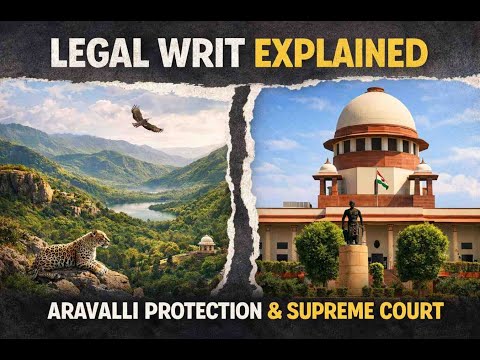
The ecological stakes are unmistakable. The Aravalli's recharge groundwater for urban and rural users across Rajasthan, Haryana and Delhi; their removal has already worsened local water tables, increased the severity of dust storms, and fragmented habitats for specialist species including large mammals and resident birds. Loss of green cover also accelerates heat island effects for adjoining cities, undermining climate resilience at a time when north-west India is experiencing more frequent heatwaves and erratic monsoon patterns. In short, continued degradation translates directly into socio-economic stress for millions - from farmers and peri-urban communities facing water shortages to city-dwellers coping with worse air and heat.
Read more : UPSC ECONOMY NOTES
Beyond the science and the politics lies a governance problem: overlapping jurisdictions, weak ground monitoring, and the lure of short-term revenue from mining undermine even strong legal rulings. Past Supreme Court orders (dating back to bans on mining in sensitive Haryana districts) reduced unlawful activity in some pockets, but enforcement gaps persisted and many violations were masked as "land levelling," farm pond construction or temporary borrow pits. The current crisis shows that law alone cannot protect a landscape unless it is matched by transparent mapping, satellite and field monitoring, meaningful penalties, community stewardship, and an accountable administrative design that aligns incentives for conservation.

So what does responsible action look like? First, the Supreme Court's science-based delineation and buffer rule must be backed by mandatory, publicly accessible Survey of India maps and a single geospatial registry for Aravalli land. Second, a clear moratorium on new mining in all core and supporting slope areas should stay in place until a state-wise, peer-reviewed Mine Planning and Sustainable Management (MPSM) regime is prepared - and only limited, low-impact mineral extraction outside inviolate zones can be considered thereafter under strict environmental clearance. Third, states must abandon revenue-record definitions of "forest" and instead adopt an ecological definition that recognises scrub, recharge patches and contiguous rocky outcrops as worthy of protection.
Fourth, degraded sites must be restored on a priority basis with native species afforestation, soil and water conservation, and re-engineering of drainage to recover aquifer recharge. Fifth, local communities should be partners: green jobs (restoration, eco-tourism, water harvesting), incentives for landowners to conserve, and participatory monitoring can align livelihoods with protection. Finally, strong deterrents - swift seizures, meaningful fines and criminal prosecution for habitual offenders are essential to change expectations on the ground.

Throughout this debate, language matters. If we equate a "development" metric only with immediate construction, we lose a far greater asset: the Aravalli's' long-term services of water security, air quality and climate regulation. As one critic put it, the range is not merely "land" to be allotted; it is a public good we inherit and must hand down. The recent Supreme Court interventions aimed at a precautionary, science-led approach provide a legal backbone; it is now for political actors, administrators and citizens to convert that backbone into durable protection on the ground.
In sum, the Aravalli issue is a test of governance choices: whether India will privilege short-term extraction or invest in ecological infrastructure whose benefits are diffused, long-term and indispensable. Choosing the latter is not anti-development - it is development redefined. As a closing thought: saving the Aravalli's today is an act of civic foresight; failing to do so will be a public debt charged to future generations.
| You Might Like | |
|---|---|
| Home – The Legal Writ | Visit Page → |
| 145+ Micro Themes for UPSC Sociology | Download PDF → |
| UPSC CAPF Previous Year Questions | Download PYQs → |
| UPSC EPFO Previous Year Question Papers | Download Papers → |